
Liquid State Theory
Overview of liquid state theory
In the chemical industry, particle interactions are typically approximated; simple experimental measurement will allow for improved formulations, from personal care products to pharmaceuticals to paints. We are developing and implementing a method to infer particle interactions from images, from which the particle coordinates can be extracted. This combines the fundamental science of statistical physics with the mathematical subject of inverse methods. We aim to better understand the liquid state: unlike molecular particles, particles of colloidal size are large enough to be observed by the optical microscope; however, they still undergo observable Brownian motion.
Project 1: Test particle insertion
Clare Rees-Zimmerman
Our inverse method to find the pair potentials, u(r), is based on enforcing consistency between the pair distribution function, g(r), measured separately by two different routes: the distance-histogram and test-particle insertion methods [1]. The pair distribution function is the probability distribution of finding a particle at a distance r from the centre of a reference particle. The distance-histogram method merely counts the particles present at a given distance. The test-particle insertion method equates g(r) to the ratio of the local and bulk insertion probabilities, which are in turn functions of u(r).
We both run simulations to develop the method, and run experiments to characterise particles. Recent experiments characterised COOH-functionalised melamine formaldehyde particles, which have been shown to be an excellent structural model for hard spheres [2].
We are applying the method to binary mixtures of particles, as well as exploring whether it can shed insight on the motion of active particles. In addition, we are demonstrating the advantages and limitations of our inverse method.
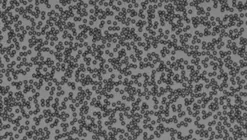
A 2D system of 2.82 μm diameter COOH-functionalised melamine formaldehyde particles, observed using brightfield microscopy.
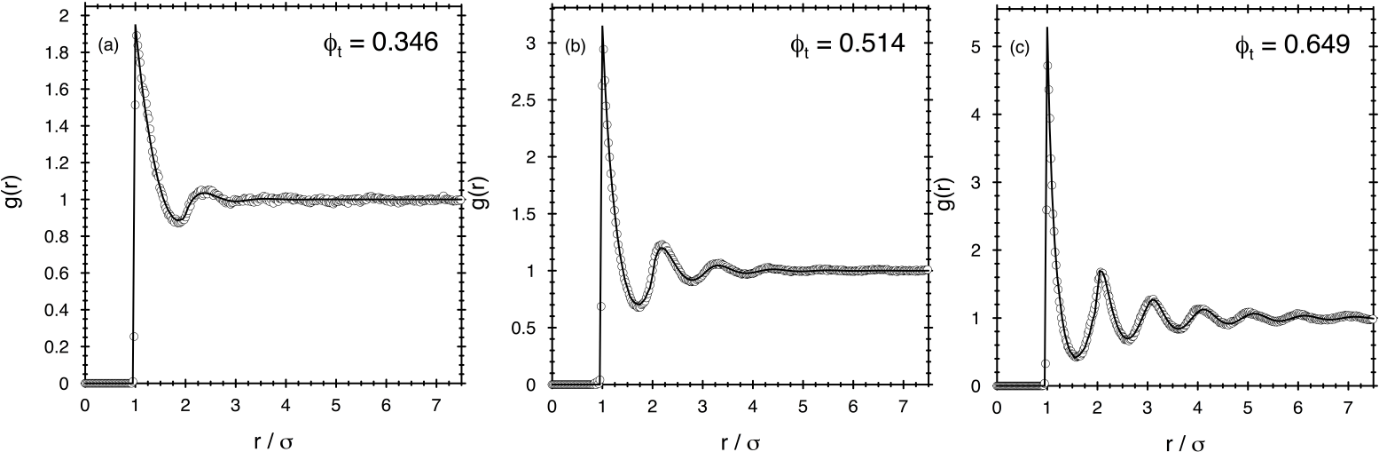
Pair correlation functions in an experimental hard disk model system.
Publications
[1] Stones, A. E., Dullens, Dullens, R. P. A., & Aarts, D. G. A. L. (2019). Model-free measurement of the pair potential in colloidal fluids using optical microscopy. Phys. Rev. Lett. 123, 098002.
[2] Thorneywork, A. L., Roth, R., Aarts, D. G. A. L., & Dullens, R. P. (2014). Communication: Radial distribution functions in a two-dimensional binary colloidal hard sphere system. J. Chem. Phys. 140, 161106.